

Martha’s Rule Summative Evaluation – Qualitative study
Do people know about Martha’s Rule, and does it help them speak up about their care?

About the qualitative research
Information for healthcare professionals, researchers and others interested in learning more
This page is for healthcare staff, researchers and other people who are interested in learning more about the qualitative research that we are doing as part of the larger Martha’s Rule Summative Evaluation. Qualitative research is about speaking to people and understanding how and why things work.
This qualitative study is being carried out by all six NIHR Patient Safety Research Collaborations (PSRCs) in the UK and is being led by Professor Rebecca Lawton at the NIHR PSRC: Yorkshire and Humber and Professor Nicola Mackintosh at the NIHR PSRC: Greater Manchester. The Principal Investigators for the wider Martha’s Rule Summative Evaluation are Prof Ramani Moonesinghe and Mr John Welch from the NIHR PSRC: Central London.
 Why are we doing this research?
Martha’s Rule is to support the early detection of deterioration by ensuring the concerns of patients, families, carers and staff are listened to and acted upon. The main aim of this research is to look at how Martha’s Rule is being put in place in hospitals, how it works in different organisations and workplace cultures and whether it is starting to change the way patients and their families are involved in their care.
Where is the research taking place?
Across the six NIHR Patient Safety Research Collaborations across England, 16 acute hospital sites each with different populations of people will take part in this part of the research. There will be a mix of teaching hospitals and district general hospitals within urban, rural and coastal geographical locations. The study will be conducted in two wards per sites (for example, respiratory, cardiology, acute medical unit, paediatrics) and involve the respective critical care outreach team or other similar responding teams or services. We will also include those teams who provide remote paediatric critical care support. These teams work in the different regions across England and are called Operational Delivery Networks (ODN).
How will we carry out the research?
This is a 30-month study which is being done in 16 hospital sites in England during and after the second phase of the rollout of Martha’s Rule. As part of this research, we will also carry out a public survey to understand more about awareness and public opinions of Martha’s Rule. This design of the study was chosen to develop a thorough national understanding of the things that help or hinder putting Martha’s Rule in practice, and to understand what effect it might have on culture, practice and inequalities.
The study will involve:
- General ward observations to understand the ward environment and culture
- Focused and structured observations of the part of Martha’s Rule that asks a patient how they are feeling on a daily basis. Often, the Patient Wellness Questionnaire (PWQ) is used to do this. Focussed observations will also happen in meetings relevant to Martha’s Rule (e.g., Safety huddles, quality improvement meetings) at each ward.
- Shadowing critical care outreach (CCO) team members (or similar teams) who are there to provide an independent review of patients. This is to observe how they work currently and now Martha’s Rule is in place
- Interviews with senior implementation leads, CCO team members, and ward staff to provide a more in-depth understanding of their awareness and experiences of Martha’s Rule and the effect it has had on practice, culture and inequalities
- Interviews with patients and family members from participating wards or those who have escalated concerns
- To understand more about how Martha’s Rule has been put into practice, we will collect and review important, relevant documents at each site. These include things such as Standard Operating Procedures (SOPs), implementation guidance, communication materials, structured patient wellness question aids, and recording forms
- We will also distribute a national public survey in collaboration with YouGov (a global public opinion and data company) and Care Opinion to explore the public’s awareness and perceptions of Martha’s Rule.
The data above will be collected across two timepoints in the first 18 months of data collection.
How will we make sense of the data?
The researchers will review the information they collect to identify common themes, patterns, and important findings (thematic analysis). They will also create a “pen portrait” for each of the 16 sites. This basically means a short, detailed summary describing what happened at each site and what was observed there.
At two of the sites, researchers will record and analyse conversations between staff and patients (excluding children under 15). They will use a method called conversation analysis, which looks closely at how people communicate—for example, what is said, how questions are asked, how people respond, and how the conversation develops. The researchers at these two sites are working with the Greater Manchester Patient Safety Research Collaboration, which has specialist knowledge of conversation analysis.
Survey results will also be analysed statistically. This will include both descriptive statistics (summarising the results, such as percentages, averages, and numbers) and inferential statistics (looking at the data to see whether any differences or relationships found are likely to be meaningful rather than simply due to chance).
How will we communicate the findings?
Alongside conference presentations and journal publications, we will work with our Public Advisory Group to generate creative and accessible documents and videos to communicate the findings of our research for lay audiences and community groups who have contributed to the research.
We will also work with stakeholders (e.g. DHSC, NHS England, Patient Safety Commissioner, Patient Safety Collaboratives, etc.) to communicate the findings and to develop recommendations that will:
- Be useful to policy makers, regional and local leads in supporting the longer-term implementation of Martha’s Rule
- Provide recommendations or a mandate for future national policy implementation
- Help organisations develop responsive systems that enable patient/carer involvement without increasing health inequalities
The qualitative research team
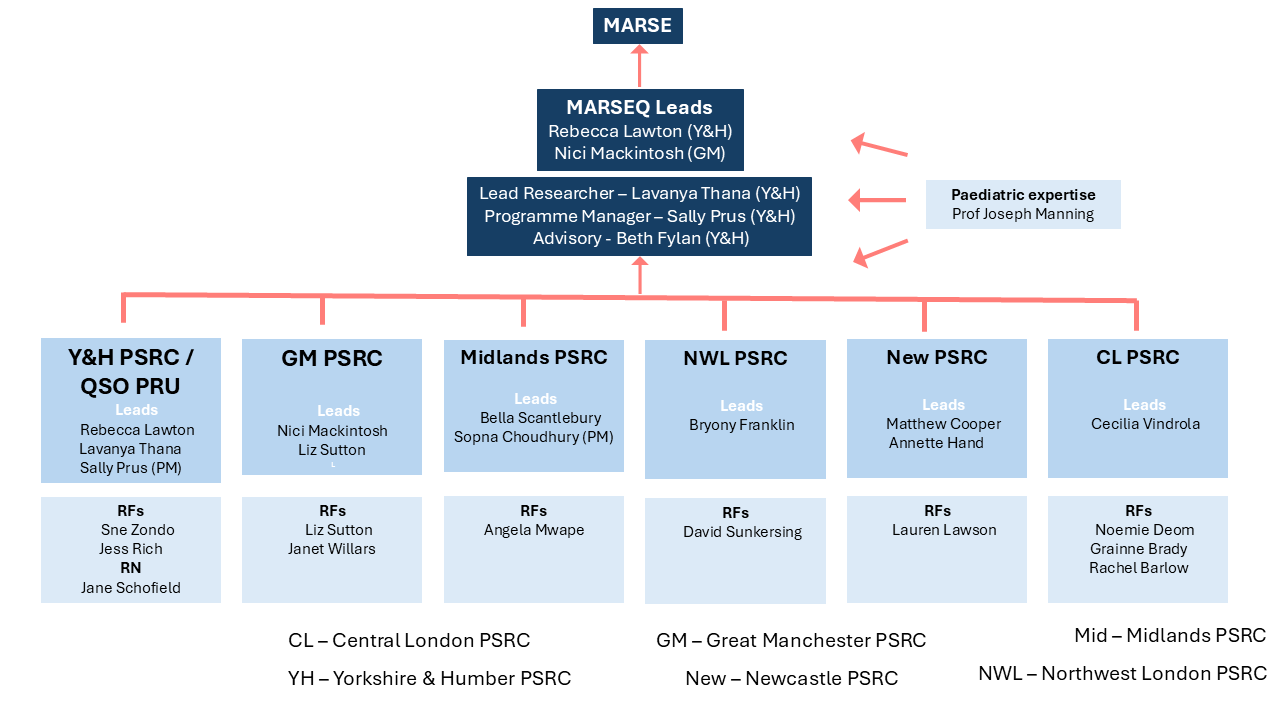
The Martha’s Rule Summative Evaluation is funded by the National Institute of Health and Care Research (NIHR) and is conducted by the six NIHR Patient Safety Research Collaborations (PSRCs), under the leadership of the NIHR Central London PSRC.



PSRC network
NIHR PSRC: Central London
NIHR PSRC: Greater Manchester
NIHR PSRC: Midlands
NIHR PSRC: Newcastle
NIHR PSRC: North West London
NIHR PSRC: Yorkshire & Humber
Copyright © NIHR PSRC Network. All rights reserved.
Site hosted by The University of Manchester.